Introduction
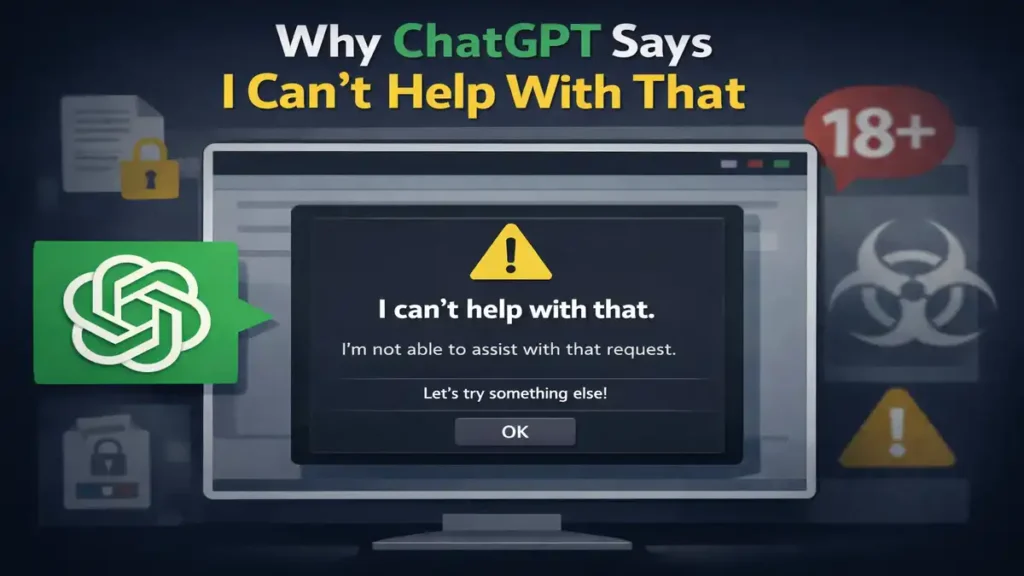
Why ChatGPT Says I Can’t Help With That ? Real Reason Revealed Explained
why chatgpt says i can’t help with that when the system detects that a request may conflict with its safety policies or responsible AI guidelines. These restrictions are not random. They are carefully designed to prevent harmful, illegal, misleading, or privacy-violating content from being generated.
AI models are trained using a combination of licensed data, publicly available information, and human feedback. During training, the system learns not only how to answer questions but also how to recognize risky or sensitive instructions. When a prompt appears to involve dangerous activity, private information, copyrighted material, or unethical intent, the model responds with a refusal instead of generating unsafe content.
Understanding why ChatGPT says I can’t help with that helps users realize that this message is a built-in safety feature — not an error. It protects both the user and the platform by preventing misuse, reducing misinformation, and ensuring responsible AI interaction.
Why ChatGPT Says I Can’t Help With That Message Appears
Why ChatGPT Says I Can’t Help With That: Main Reasons ExplainedThe refusal message appears when the AI detects that a request may violate its safety guidelines or content policies. These rules are not random; they are carefully designed to prevent misuse and to keep information safe, ethical, and accurate.
AI models are trained using a mixture of public data, licensed data, and human feedback. During training, they learn patterns not only for answering questions but also for identifying risky instructions. If a prompt appears to involve harmful activity, private information, or restricted content, the system automatically declines.
This refusal protects both the user and the platform. It prevents the spread of dangerous instructions, stops misinformation, and reduces the risk of legal or ethical issues.
How to Avoid the Why ChatGPT Says I Can’t Help With That Response
Safety and Ethical Guidelines
One of the biggest reasons for refusal is safety. AI systems are programmed to avoid producing content that could harm individuals or society. For example, requests involving violence, illegal actions, or manipulation will almost always trigger a refusal.
Requests Related to Illegal Activities
If a user asks for instructions to hack accounts, bypass security systems, or perform unlawful acts, the system declines immediately. This ensures the AI is not used as a tool for wrongdoing.
Privacy and Personal Data Concerns
ChatGPT will not provide personal data about real individuals, such as addresses, phone numbers, or sensitive records. Even if the request seems harmless, sharing such information would violate privacy principles.
https://openai.com/policies/usage-policies/Copyrighted or Restricted Material
Another common trigger is asking for full copyrighted books, movies, or paid articles. The AI may summarize or explain, but it avoids reproducing protected content word-for-word.
Medical, Legal, or Financial Risk
The AI can provide general educational information, but it refuses to give high-risk professional advice that could lead to harm if misunderstood. This includes diagnosing diseases, giving legal strategies, or offering guaranteed investment tips.
How to Avoid the Why ChatGPT Says I Can’t Help With That Response
Harmful or Dangerous Instructions
Questions about making weapons, breaking into systems, or harming others will be declined instantly.
Requests for Sensitive Information
Asking for private details about celebrities, businesses, or individuals can result in refusal.
Manipulative or Deceptive Content
If a user requests help writing scams, fake reviews, or misleading messages, the AI will refuse to assist.
Explicit or Restricted Content
Some adult or graphic requests may also trigger safety filters, depending on their nature.
How to Avoid the “I Can’t Help With That” Message
Rephrase Your Prompt Clearly
Often the refusal happens because the wording sounds risky. Instead of asking for something directly harmful, frame it as an educational or informational question.
Example:
❌ “How do I hack a website?”
✅ “How does website security work and how can it be improved?”
The second version focuses on learning, so the AI can respond safely.
Ask for Educational Explanations
AI responds best when questions are framed around understanding concepts rather than performing harmful actions.
Provide Context
If your request is legitimate, explain your purpose. For example, say you are researching cybersecurity for study. Context helps the system interpret the prompt correctly.
Break Complex Requests Into Steps
Sometimes a big request sounds suspicious. Splitting it into smaller, neutral questions improves success.
Can ChatGPT Ever Answer These Questions Later?
When the Answer May Change
If the refusal was caused by unclear wording, rewriting the prompt can often produce a helpful response.
Limits That Cannot Be Bypassed
However, some restrictions are permanent. The AI will never provide illegal instructions, personal data leaks, or dangerous guidance. These limits exist regardless of how the question is phrased.
Why These Restrictions Are Important
Safety filters are not just technical barriers—they are essential for responsible AI use. Without them, AI could be misused for scams, harassment, or unsafe instructions. By refusing certain requests, the system encourages constructive and ethical interaction.
For users, this means learning to communicate with AI in a smarter way. When you understand the boundaries, you can get better answers faster and avoid frustration.
Practical Tips for Better AI Conversations
- Be specific but safe – Ask exactly what you want, but avoid risky wording.
- Focus on learning – Educational questions rarely trigger refusal.
- Use neutral language – Avoid words associated with illegal or harmful actions.
- Check intent – If your request could be misused, the AI may decline it.
- Rewrite calmly – A simple rephrase often solves the issue.
FAQ
Why does ChatGPT refuse some prompts?
It refuses prompts that may violate safety rules, involve illegal activity, or request sensitive or restricted information.
Is the refusal message a bug?
No. It is a built-in safety feature designed to ensure responsible AI usage.
Can I bypass ChatGPT safety rules?
No. Core safety restrictions cannot be bypassed, though rephrasing a safe question may help if the refusal was due to unclear wording.
How do I rewrite a prompt to avoid refusal?
Focus on educational intent, use neutral language, and avoid asking for harmful or restricted actions directly.
Does refusal mean ChatGPT doesn’t know the answer?
Not necessarily. Often the AI knows the topic but cannot provide the response due to policy limitations.
Conclusion
Understanding why ChatGPT says I can’t help with that makes using AI much easier and more productive. The refusal message is not an error but a protective mechanism that ensures safe, legal, and ethical responses. By learning how AI interprets prompts and adjusting your wording, you can avoid most refusals and get more accurate answers. Treat AI as a learning assistant rather than a tool for risky or restricted requests, and you’ll find it far more helpful in research, writing, and everyday tasks. With the right approach, ChatGPT becomes a powerful partner for knowledge, creativity, and problem-solving.